


Antizionist protesters shouted slurs at elected officials visiting New Orleans for a summit to fight Jew-hatred. {Photo by Jordan Isrow}
Parkland City Commissioner Jordan Isrow was walking through the streets of New Orleans with fellow elected officials recently when the angry chants began.
“Heil Hitler!
“Dirty Jew, go home!”



“From the river to the sea, Palestine will be free!”
The moment, described in an evocative Facebook post by Isrow, came during a second-line style march tied to the Combat Antisemitism Movement’s 2025 North American Mayors Summit, held Dec. 2 – 4 in the Big Easy. What began as a celebratory procession quickly turned into something more disturbing, Isrow wrote, when a group of demonstrators spewing Jew-hatred showed up to confront the attendees, many of them Jewish.
“A large group of anti-Israel protesters and neo-Nazi agitators had learned about the Summit and showed up to antagonize,” Isrow wrote. “Yes, there were people actually shouting ‘Heil Hitler!’ At a group of elected officials. In public. In 2025. If that’s not a sign of the times, I don’t know what is.”
Caught between disbelief and fear, Isrow said he struggled to process what was happening.



























“In a moment of shocked uncertainty – not knowing whether to laugh or be afraid (I chose both) – I did what any respectable man would do,” he wrote. “I FaceTimed my wife.”
On the other end of the call, Jessica Isrow listened along with their five-year-old daughter, Maya. For a moment, they watched as protesters shouted what Isrow described as “hateful, centuries-old tropes about Jews.”
The New Orleans Police Department, he wrote, kept the protesters at a distance and ensured the officials’ safety. But the antisemites’ shouted rhetoric about Jews and Israel were relentless.
“It was so loud I told them I’d have to call again in the morning,” Isrow wrote.
The confrontation itself was jarring. But it was what came next that left the deepest mark.
“When I FaceTimed the kids before school, Maya asked me, with concern in her voice: ‘Daddy, why do you have to be there?’” Isrow wrote.
He tried to explain, in language a five-year-old could understand, why he had traveled to New Orleans. “I’m here to help fight against antisemitism,” he told her, “which means stopping people who hate Jews, so that you and Parker (Isrow’s son) never have to worry about angry and mean people like you saw yesterday.”
Maya then asked a question no Jewish child should have to ask, but which parents are hearing more frequently as Jew-hatred surges to unprecedented levels in the U.S.



She said: “Why do people hate Jews?” “I told her, ‘That’s a very good question,” said Isrow. “Unfortunately, I don’t have a very good answer.’”
Then came another question Isrow said he will never forget.
“Then why do we have to be Jewish?” Maya asked.
“The logic in her five-year-old mind made perfect sense,” Isrow wrote. If being Jewish invites danger, why choose it at all?
Isrow said he tried to explain that Jewish identity is not an obligation imposed, but a choice — rooted in values, traditions, and lessons passed down through generations. A way of honoring history, resilience, and survival.
“We proudly choose to be Jewish because our parents instilled in us certain values, lessons, morals, and traditions passed down through generations. And that through those traditions, we honor our history — our grit, our perseverance — that has allowed us not just to survive but thrive in the face of adversity,” Isrow explained.
But he could see he was losing his daughter. That’s to be expected, considering how the history and intricacies of Jew-hatred – the world’s oldest and most deeply studied form of prejudice – could fill innumerable libraries. Some scholars believe there is an ancient reflex awakened in societies in times of strife and uncertainty, a reflex resulting in the scapegoating of Jews.
Adam Louis-Klein, an anthropologist and founder of the Movement Against Antizionism initiative, which fights antizionist prejudice, has said bigotry related to Israel is the main form of hatred targeting Jews globally today. Antizionism casts Israel and its supporters as uniquely evil, recycling old antisemitic narratives under new progressive and anti-imperialist language.
“In the same way in which antisemitism once cast the Jew as the world’s metaphysical enemy, antizionism now casts Israel and its supporters in the same role,” Louis-Klein has said.
All of which is a lot for any Jewish kid to take in.
Instead of a history lesson, Isrow spoke to his little girl from the heart: “I told her that even I don’t really understand why people hate us — only that we will always protect her and her brother, and we will do whatever it takes to ensure they never have to worry about being hurt or treated differently for simply being Jewish.”
The proud father, commissioner, and attorney said his “why” became clearer than ever at that moment.
“To ensure a safe and peaceful future for my kids — one where they will never face the question from their own children: ‘Why do people hate Jews?’”
In an interview with Parkland Talk, Isrow said his daughter’s questions crystallized something he had been feeling since the Hamas-led invasion of Israel on Oct. 7, 2023, after which global Jew-hatred exploded. The commissioner said he’d felt a shift from discomfort to something closer to fear for Jewish communities.
“I grew up in Boca Raton. I was exposed to antisemitism growing up — jokes, comments, kids saying stupid things,” he said. “That never really bothered me. After October 7 was the first time in my life I actually felt a threat.”
That sense of vulnerability, he said, was sharpened by parenthood. Sending his children to Jewish day school now involves armed security and vehicle checks — measures that would have once sounded outlandish, but are now routine for Jewish families worldwide.
“This is no longer just people saying things that make you uncomfortable,” Isrow said.
The antisemitism summit itself, he said, reinforced both the scale of the problem and the urgency of local action. The Combat Antisemitism Movement focuses heavily on municipal leadership, based on the belief that real change often begins at the local level.
“People may tune out national politics,” Isrow said. “But when something happens in their community, they pay attention.”
Panels at the summit dealt with enforcement of hate-crime statutes, the push to adopt a standardized definition of antisemitism developed by the International Holocaust Remembrance Alliance, and the challenges of moderating hate online without eroding free speech.
One discussion featured Meta’s director of content policy, who spoke candidly about the difficulty of curbing antisemitism on social platforms.
“Spoiler alert: they’re losing,” Isrow wrote afterward.
Notable speakers at the summit included New York City Mayor Eric Adams; Phyllis Dickerson, CEO of the African American Mayors Association; and U.S. Antisemitism Special Envoy Nominee Rabbi Yehuda Kaploun. Local Jewish officials in attendance included Coral Springs Mayor Scott Brook and Tamarac Mayor Michelle Gomez.
Among the summit events that stuck with Isrow: a talk by a counterterrorism expert who described how modern extremist movements increasingly operate not through isolated violence, but through long-term influence campaigns, money, and policy advocacy.
“That really opened my eyes,” Isrow said. “A lot of people still picture terrorism as someone in a bomb vest. The reality now is much more sophisticated.”
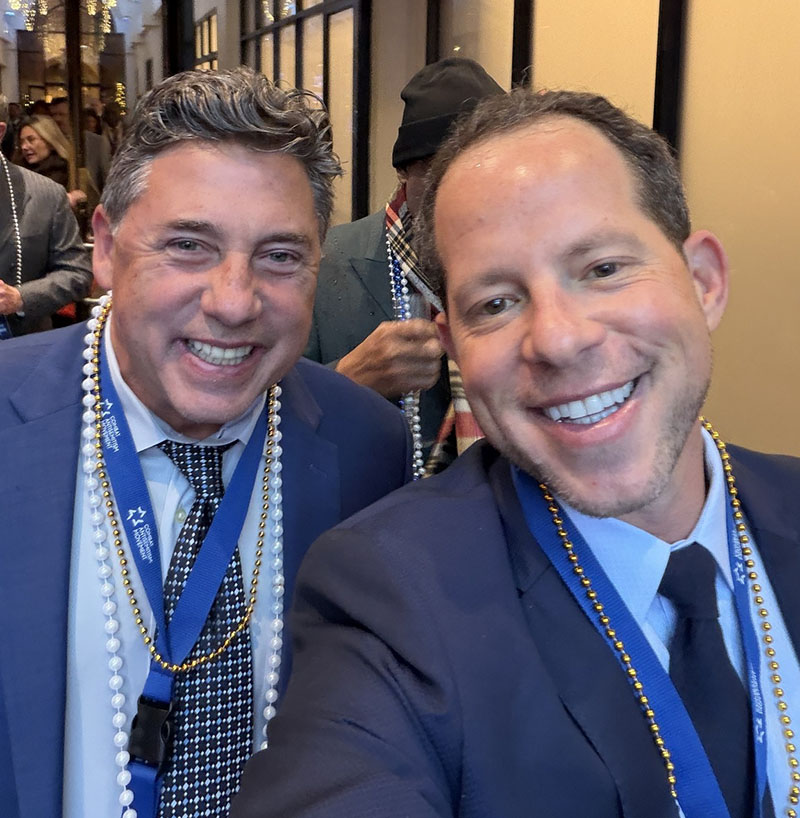
Parkland Commissioner Jordan Isrow (on right) with Coral Springs Mayor Scott Brook in New Orleans. {Jordan Isrow}
He also reflected on New Orleans’ Jewish history — one of the oldest Jewish communities in the U.S., dating back to the 18th century — and on symbolic moments like walking onto the field at the Superdome.
Isrow credited former Bal Harbour Mayor Gabe Groisman with encouraging his involvement and helping draw him into the work of fighting Jew-hatred.
But it was the encounter in the street, and his daughter’s questions afterward, that stayed with him.
For Isrow, the most troubling part was not just the presence of protesters targeting an event held to fight discrimination, but their confidence — shouting slurs in public, at elected officials, in broad daylight.
“That tells me there’s an environment being incubated that makes people think that’s OK,” he said.
And yet, the commissioner wrote, the antisemitism summit reminded him there is still a “strong force for good in the world — it’s just fragmented and needs courageous leadership to help bridge divides and bring together enough light to overcome the rapidly increasing dark.”
He said it’s important that all people who care about their neighbors, communities, and country stand up to hatred and for the rule of law, because when mass prejudice takes hold in a society, history has shown that every group – and society itself – is irrevocably harmed.
“Stop sitting on the sidelines. Don’t stay silent,” Isrow wrote. “Stand up and fight for what’s right, so that our children and grandchildren won’t have to. Their futures depend on us.”
“I don’t think I could ever look my kids in the eye and say I sat around and did nothing,” Isrow said of fighting Jew-hatred. “That’s not an option.”
Send your news to Parkland’s #1 Award-Winning News Source, Parkland Talk. Don’t Miss Tamarac Talk, Coral Springs Talk, Coconut Creek Talk, Margate Talk, and Sunrise FL Talk.
Author Profile
Related
 NewsAugust 19, 2026MSD Grad Sam Fisher Helps Israel Lacrosse Make History on World Stage
 NewsAugust 10, 2026Bomb Threat Reported at Marjory Stoneman Douglas High School on First Day of School
 NewsJune 24, 2026School Board Approves $14 Million Sale of Parkland Land to Broward Health
 NewsMay 31, 2026Parkland Ranked Florida’s Best Place to Live, Cracks Top 15 Nationally
